Skip to content

Your research digest, every morning

Each morning ReadSearch reads the new papers in the fields you follow and brings you the few worth your time, ranked for you and explained in plain language.

Free for 14 days. No payment details to start.

Today’s digest

Friday 2 October

6 papers for a cardiologist · about 9 min

  1. 01Semaglutide and cardiovascular outcomes in adults with overweight or obesity and established cardiovascular disease without diabetes96 fit · The Lancet · open
  2. 02Continuous glucose monitoring in non-diabetic heart failure: a pilot cohort91 fit · Circulation
  3. 03External validation of a transformer triage model across four health systems88 fit · medRxiv
  4. 04Tirzepatide dosing in renal impairment84 fit · NEJM
  5. 05Sodium restriction and readmission after acute decompensation81 fit · JAMA Cardiology
  6. 06Wearable-derived atrial fibrillation burden and stroke risk80 fit · Heart Rhythm

1. Overview

A weight-loss drug that also protects the heart

Semaglutide is widely used for diabetes and obesity. Whether it also prevents heart attacks and strokes in people without diabetes has been an open question for cardiologists.

This trial randomised adults with overweight or obesity and established cardiovascular disease, none with diabetes, to weekly semaglutide or placebo, and followed them for major cardiovascular events.


2. The problem

The gap it addresses

Most cardiovascular outcome trials of GLP-1 drugs enrolled people with type 2 diabetes. For the much larger group with overweight or obesity and established heart disease but no diabetes, the evidence was indirect.

3. The idea

A placebo-controlled outcomes trial

Lowering weight and inflammation with semaglutide will reduce cardiovascular events even without diabetes.

Earlier diabetes trials showed fewer events than glucose lowering alone would explain, which pointed to effects beyond blood sugar: on weight, blood pressure and inflammation.

4. The method

Randomised, double-blind, event-driven

Neither participants nor investigators knew who received the drug, and the trial ran until a pre-set number of primary events had accrued, so its size was fixed by events rather than by time.

  1. Adults aged 45 or over with a BMI of 27 or more and prior heart attack, stroke or peripheral artery disease were enrolled.
  2. They were randomised one to one to weekly semaglutide 2.4 mg or placebo, on top of standard care.
  3. The primary outcome was the first of cardiovascular death, heart attack or stroke.
  4. Follow-up continued until enough events had occurred, a mean of 3.3 years.
  • Population

    Established cardiovascular disease, overweight or obesity, no diabetes.

  • Comparison

    Placebo, with standard cardiovascular care in both groups.

  • Primary outcome

    A composite of cardiovascular death, non-fatal heart attack and non-fatal stroke.

What is new: The first large outcomes trial of a GLP-1 drug in people without diabetes.

5. What they found

The results

20%
Fewer major events
Relative reduction in the primary composite outcome versus placebo.
−9.4%
Weight change
Mean change in body weight with semaglutide, against −0.9% with placebo.
3.3 yrs
Follow-up
Mean time participants were followed.
16.6%
Stopped for side effects
Mostly gastrointestinal, against 8.2% on placebo.
% with a major event
Semaglutide6.5
Placebo8

Major cardiovascular events occurred in 6.5% of the semaglutide group and 8.0% of the placebo group. The benefit appeared early, before most of the weight loss, which suggests effects beyond weight alone. More people stopped the drug because of side effects.

6. Use cases

Where it could be used

  • Secondary prevention

    An added option for patients with heart disease and obesity who do not have diabetes.

  • Guideline updates

    Evidence that cardiology and obesity guidelines can weigh when recommending GLP-1 drugs.

  • Shared decisions

    Concrete numbers to discuss benefits against side effects and cost with patients.

7. In your field

For a cardiologist, this moves semaglutide from a weight drug to a prevention option.

  • Who might qualify

    Patients like those in the trial: established disease, a BMI of 27 or more, no diabetes.

  • What to watch

    Gastrointestinal side effects drove most discontinuations, so follow-up in the first months matters.

  • Open questions

    Whether the benefit holds at lower doses, and how it compares with other risk-lowering drugs.

1 in 67Patients treated over about three years for one fewer major event, from the absolute difference of 1.5 points.

8. Next steps

What to do with it

  • Read the methods and supplement

    Check the population, the adjudication of events and the subgroup results.

  • Compare with the diabetes trials

    Set this result beside the earlier GLP-1 outcome trials to see what is new.

  • Check the guideline response

    Look for how cardiology societies have incorporated it.

A sample edition, dated today: a cardiologist’s morning digest, and its first paper explained slide by slide. The papers are samples.

New papers every day from

  • PubMed
  • arXiv
  • bioRxiv
  • medRxiv
  • OpenAlex
How it works

Explained plainly

From the abstract to what it means

The same paper, as its authors wrote it, and as your digest gives it to you. A sample paper.

The abstract

201 words · 12 abbreviations and symbols

Background: Glucagon-like peptide-1 receptor agonists (GLP-1 RAs) reduce major adverse cardiovascular events (MACE) in type 2 diabetes (T2D); whether semaglutide confers cardiovascular benefit in patients with established atherosclerotic cardiovascular disease (ASCVD) and overweight or obesity in the absence of diabetes has not been established. Methods: In this multicentre, double-blind, randomised, placebo-controlled, event-driven superiority trial, patients aged ≥45 years with prior myocardial infarction (MI), stroke or symptomatic peripheral artery disease (PAD) and a body-mass index (BMI) ≥27 kg/m², without diabetes, were assigned 1:1 to once-weekly subcutaneous semaglutide 2.4 mg or placebo. The primary endpoint was a composite of cardiovascular death, non-fatal MI or non-fatal stroke, analysed as time to first event. Results: Over a mean follow-up of 3.3 years, the primary endpoint occurred in 6.5% of the semaglutide group and 8.0% of the placebo group (hazard ratio [HR] 0.80; 95% confidence interval [CI] 0.72–0.90; P<0.001). Mean change in body weight was −9.4% versus −0.9%. Adverse events leading to permanent discontinuation occurred in 16.6% versus 8.2%, predominantly gastrointestinal. Conclusions: In patients with pre-existing cardiovascular disease and overweight or obesity without diabetes, weekly semaglutide 2.4 mg was superior to placebo in reducing the incidence of death from cardiovascular causes, non-fatal MI or non-fatal stroke.

Your digest

96 words · no abbreviations

In shortIn people with heart disease and obesity but no diabetes, a weekly weight-loss drug cut heart attacks, strokes and heart deaths by a fifth.

The question
Earlier trials of these drugs only enrolled people with diabetes. Would the heart benefit hold without it?
What they did
Adults with past heart disease who were overweight took the drug or a dummy injection every week for about three years.
What they found
6.5% had a major heart event on the drug, 8.0% on placebo. The benefit came early, before most of the weight loss.
The catch
Twice as many stopped the drug for side effects, mostly stomach trouble.

Machine-written, marked as such, with a link to the paper to check anything you rely on.

Today’s papers

Real papers, as your dashboard shows them

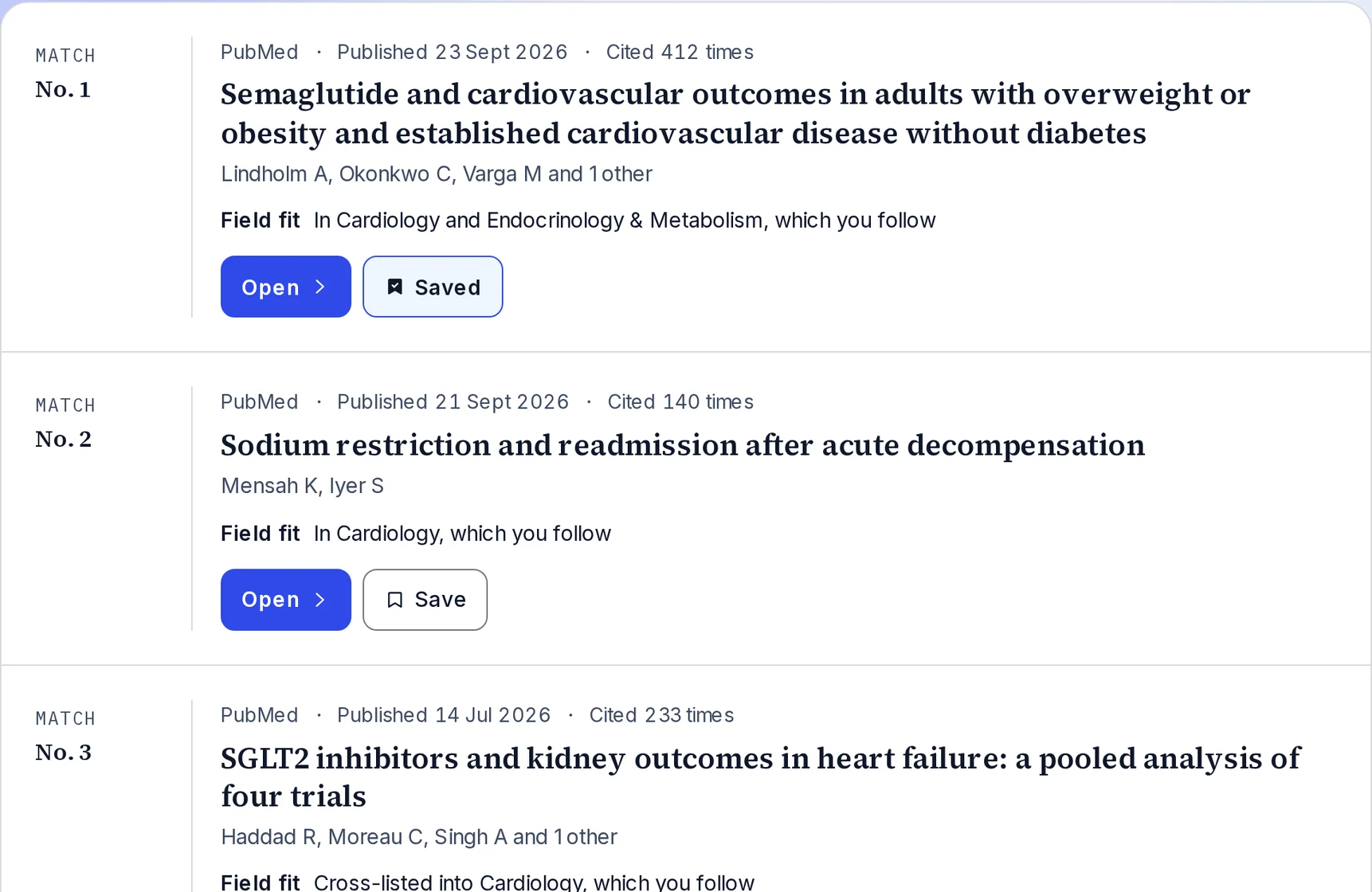
Picked today by ReadSearch’s digest for four interests. These are real papers: open any of them at its source, no account needed. Sign up and the digest is built around your own field.

Get a digest for your field

Keep up with your field without reading all of it

New papers appear faster than anyone can read them. ReadSearch reads them for you, every day, and keeps the few that matter to your work.

The daily digest

One morning read, built around your work

From choosing what it reads to the papers it brings you, in one place.

A daily digest, ranked for you

  • Every morning, the day’s new papers in your fields, scored and put in order. A handful, not a hundred.
  • Ranked against your field, the interests you follow and the methods you ask for. Mark a paper not relevant and it leaves your digest.
See a sample digest
Today’s digest: six new papers, nine minutes, in cardiology, endocrinology and clinical informatics, two of six read.A paper card from the digest, with its key finding and why it was chosen.

Choose exactly what it reads

  • One field from 113 and three or more of 246 interests, from machine learning and econometrics to cardiology and astrophysics.
  • Mark methods as preferred to rank papers that use them higher, or required to see only those. Change any of it, any day.
Set up your digest
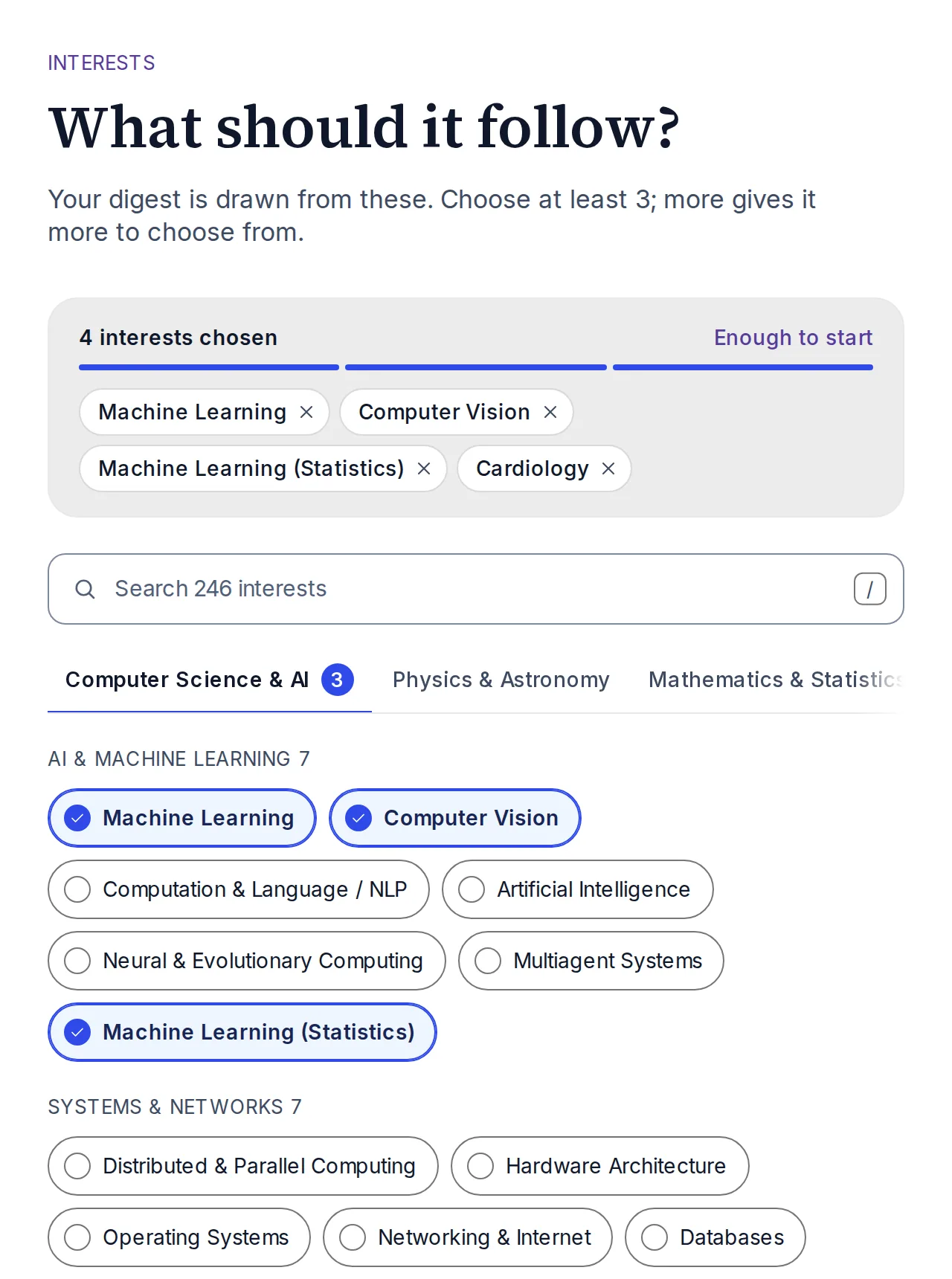
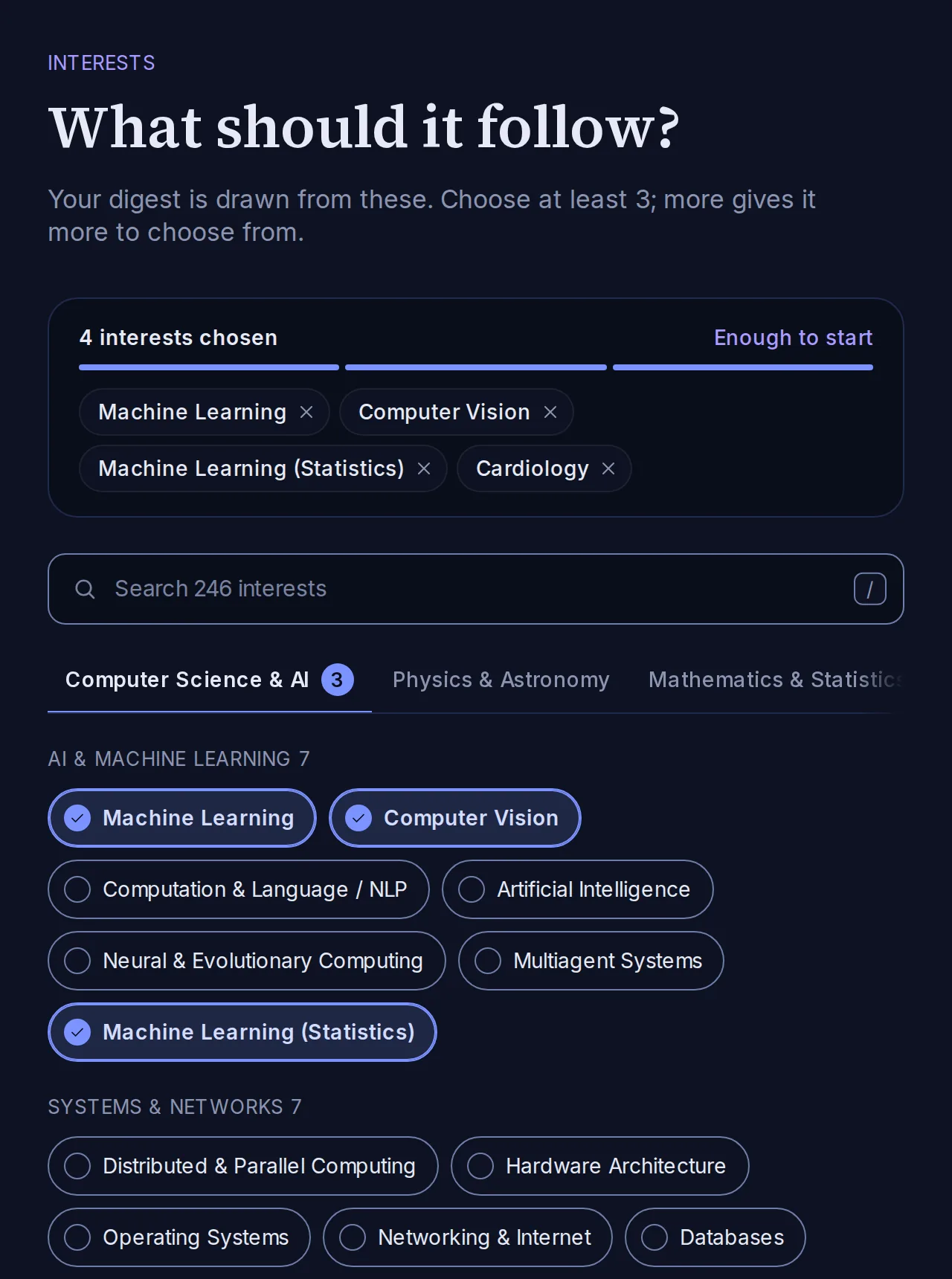
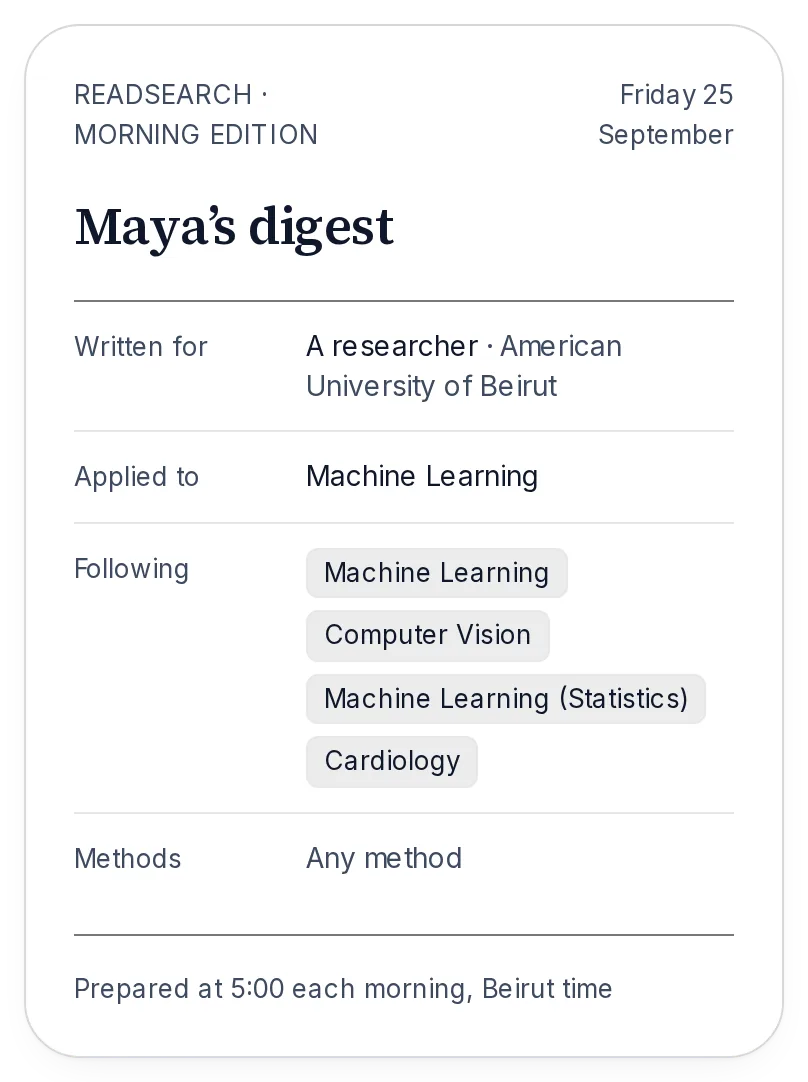
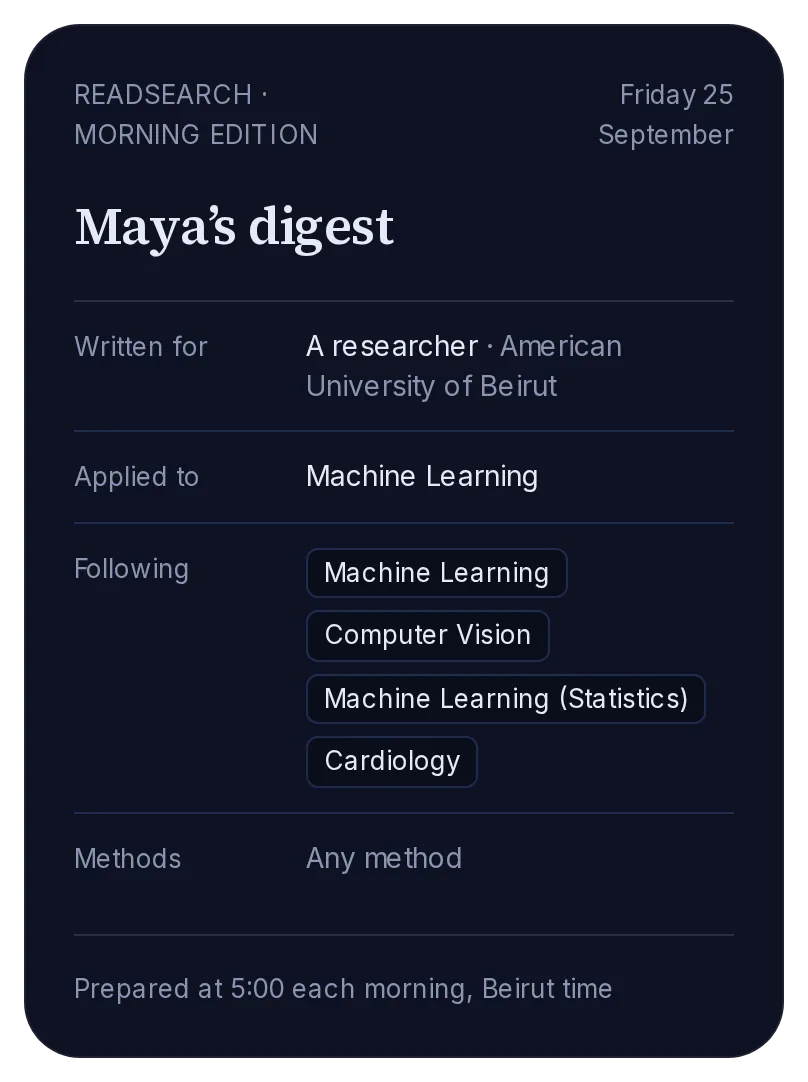
Choosing interests: machine learning, computer vision, machine learning in statistics and cardiology chosen, from 246.The digest card as it is built: written for a researcher, applied to machine learning, following four interests.

Every paper, explained plainly

  • Each paper opens with its key finding in one plain sentence, written for how you read and marked as machine-written.
  • Why it is in your digest, who wrote it and where it was published, with a link to the source to check anything you rely on.
See the paper cards
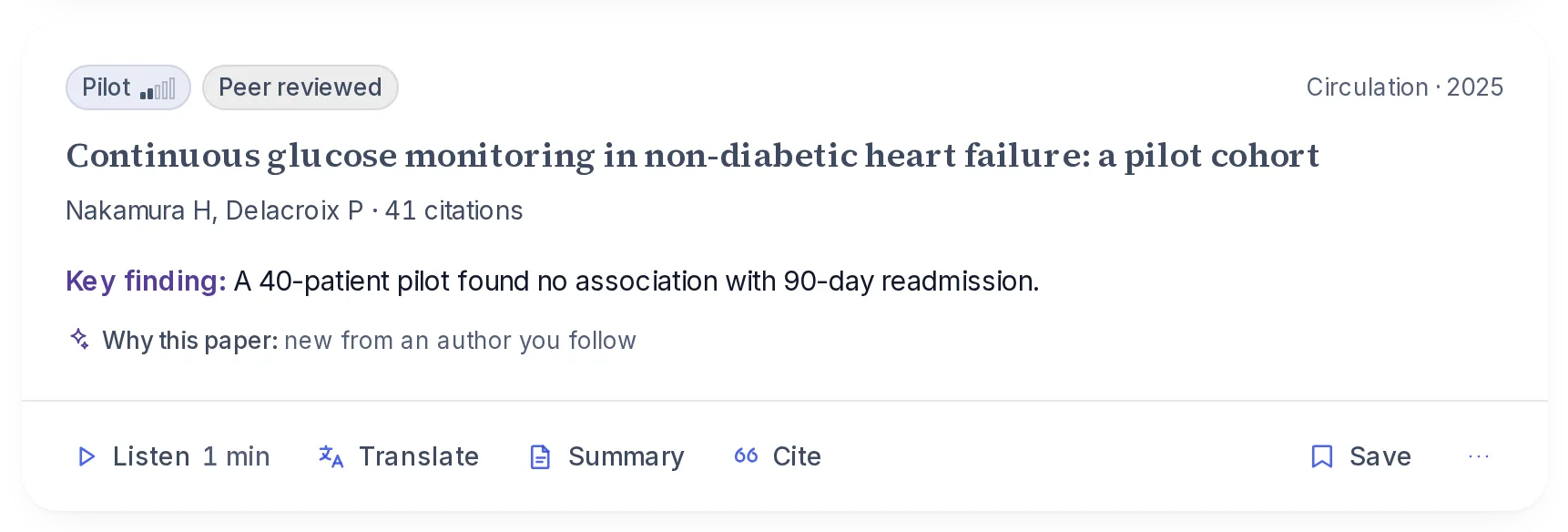
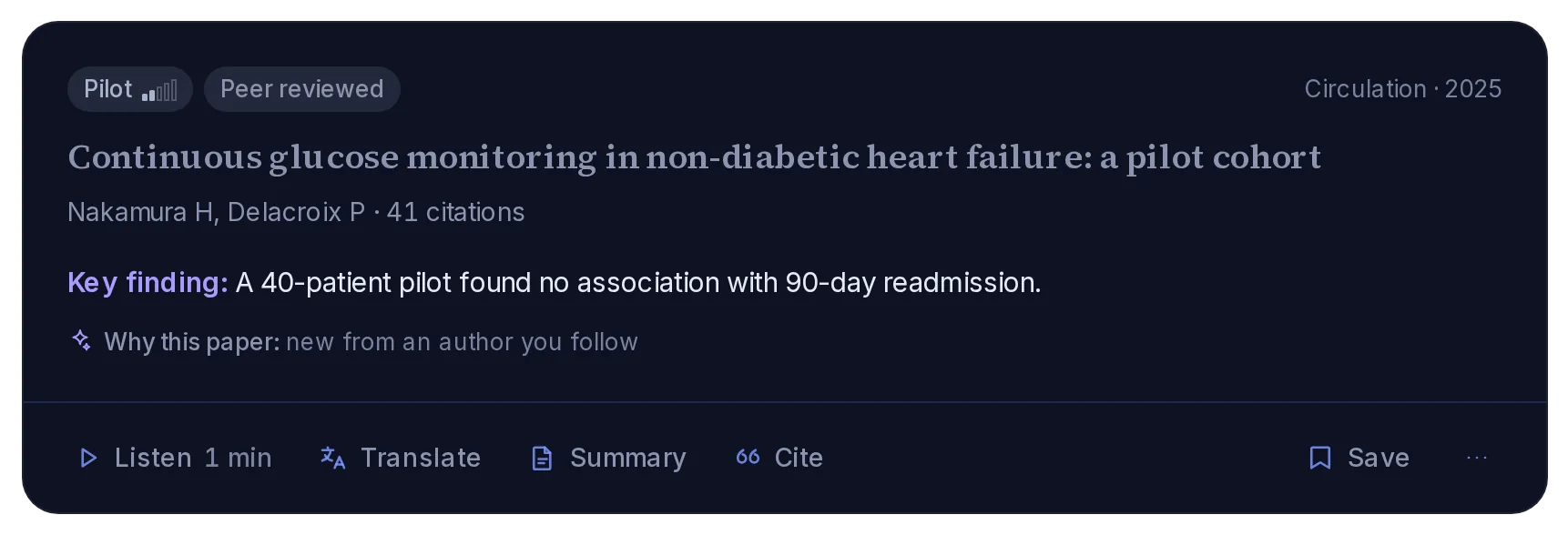
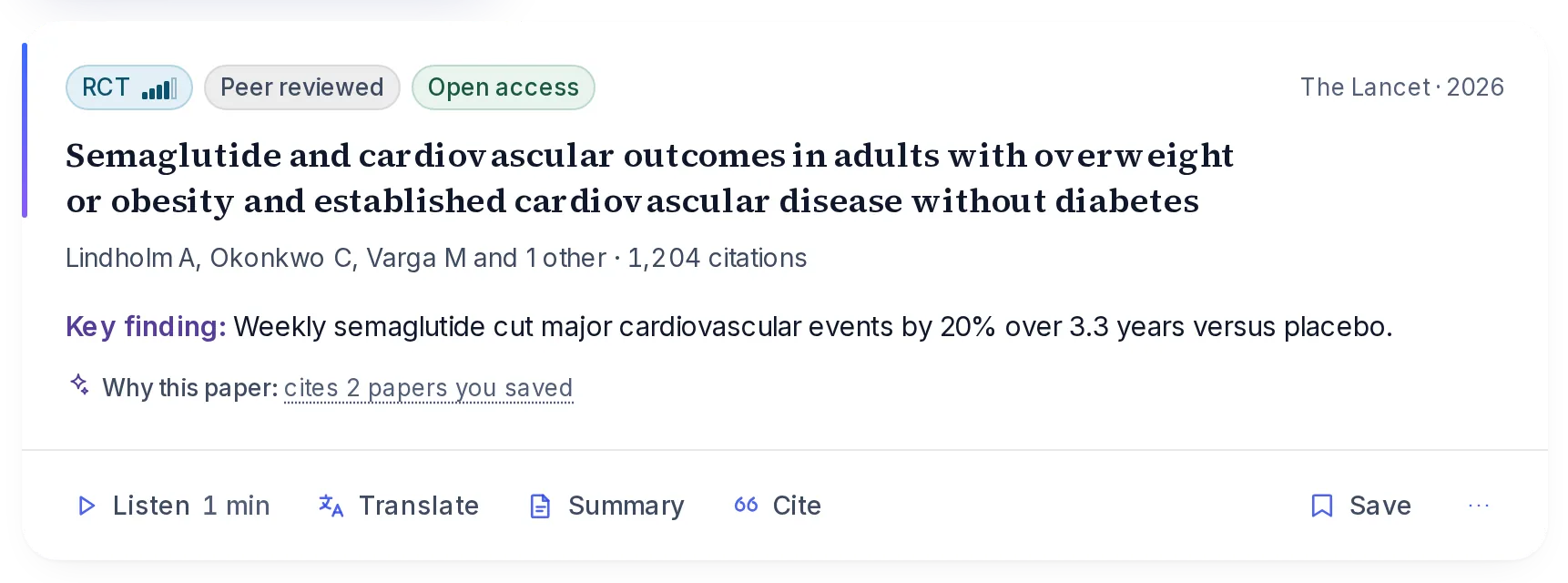
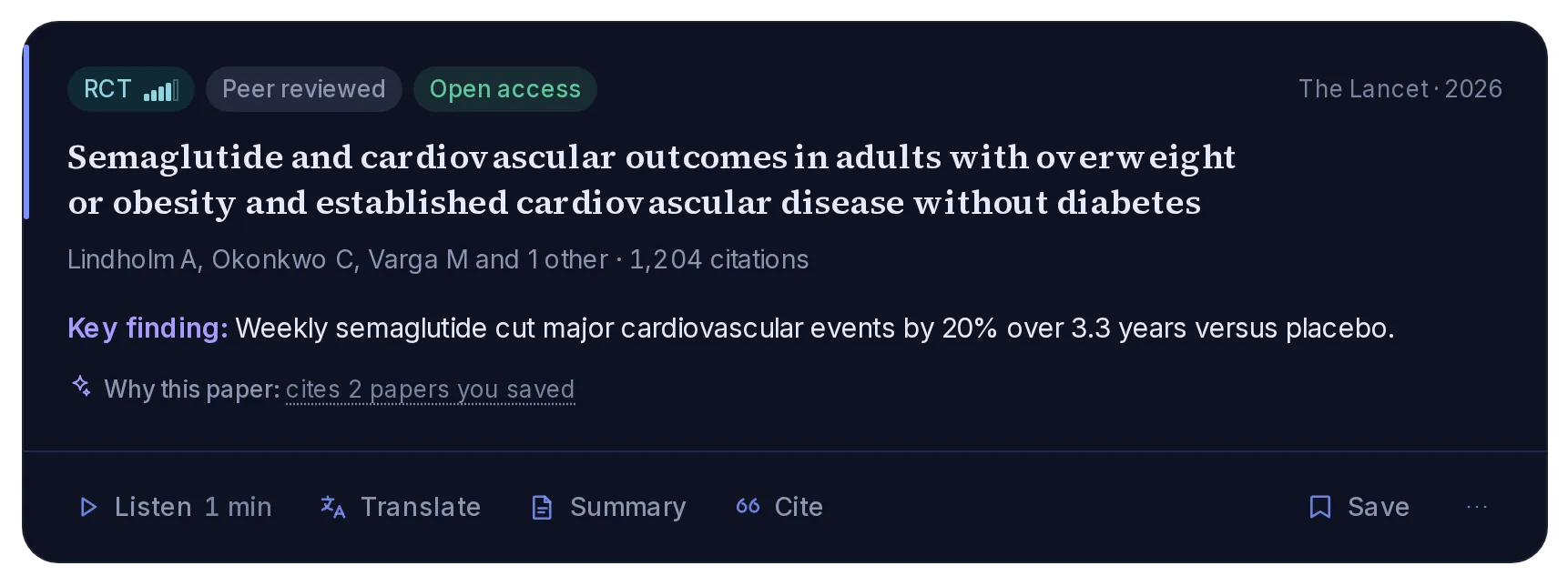
A paper card: randomised controlled trial, peer reviewed, open access, with its key finding in one sentence.A second paper card, a pilot study, with its key finding.

See your reading

  • What you have read, day by day for the last two weeks, and in all.
  • Goals, streaks and badges only if you turn them on. They stay off until you do.
Open a sample profile
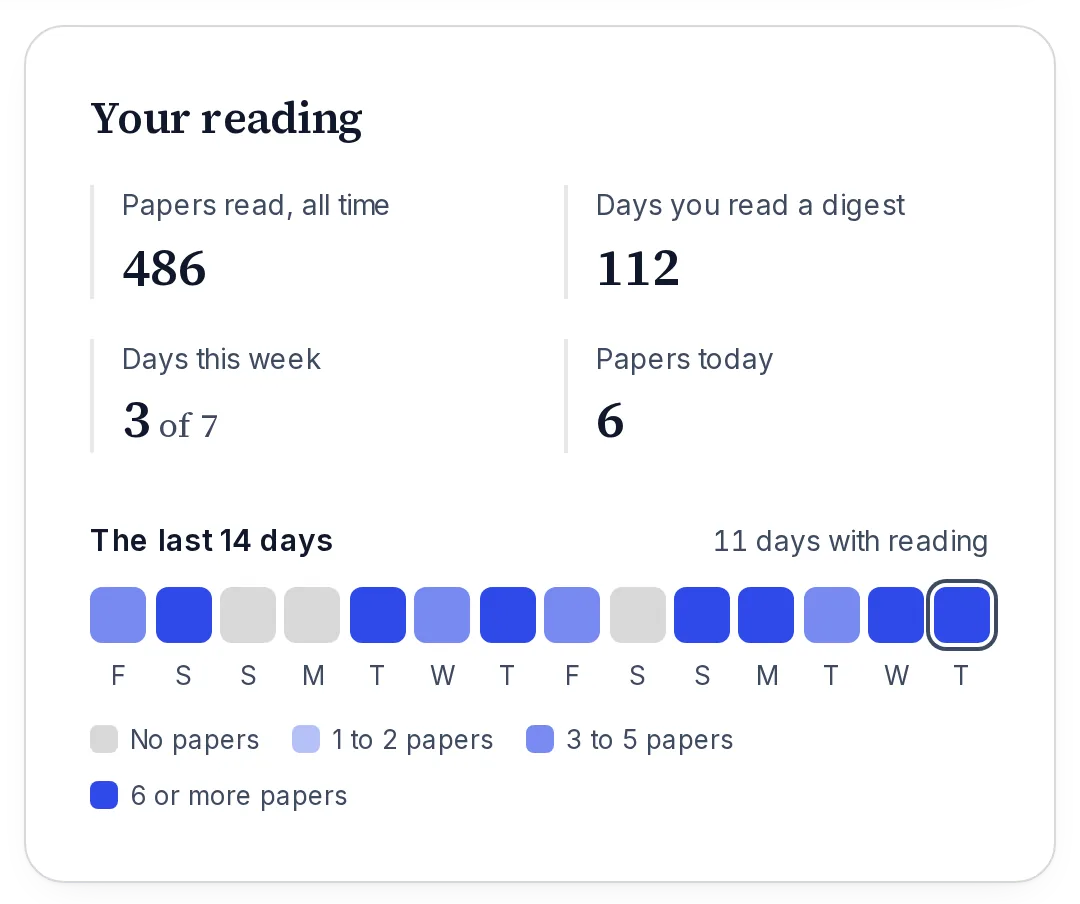
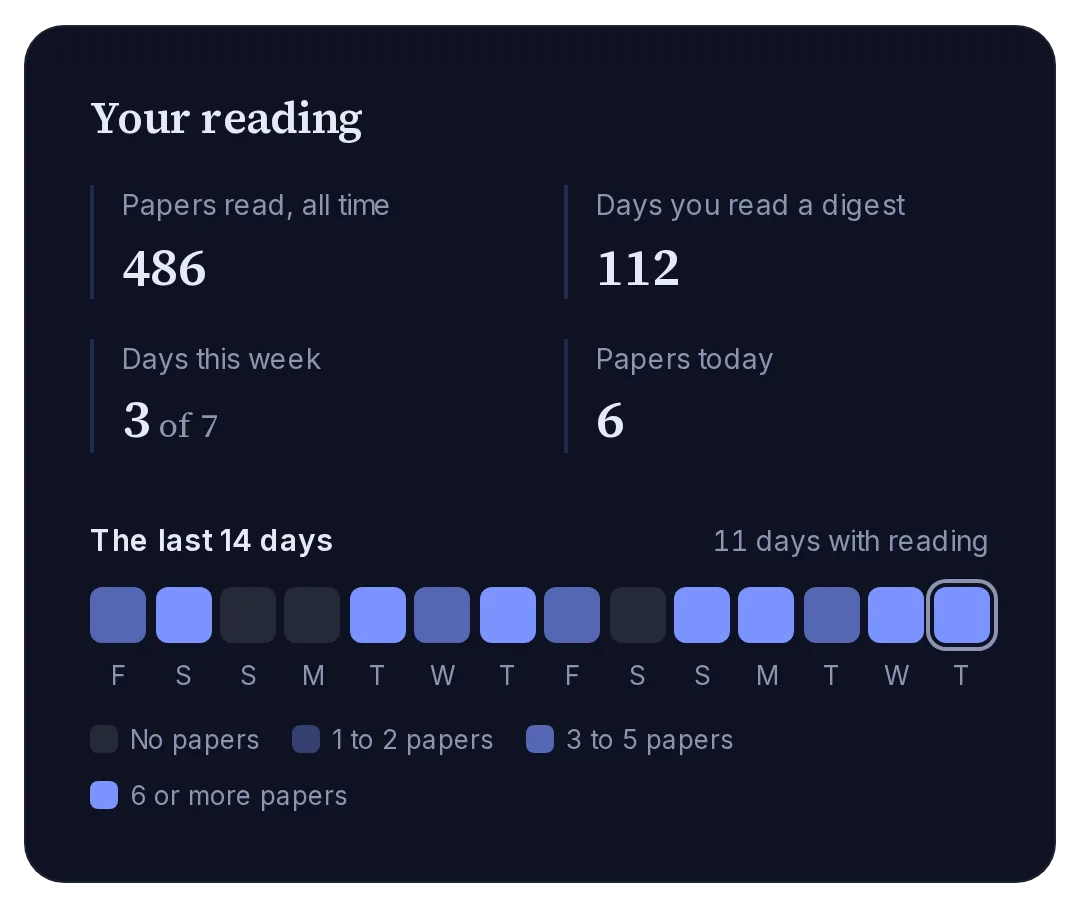
Your reading: 486 papers read, 112 days with a digest, and the last 14 days as squares by how much was read.

How it works

  1. Tell it what you work on

    Your role, one of 113 fields, three or more of 246 interests, and any methods you care about.

  2. It reads the day’s papers

    New work from 5 sources is scored against what you chose. A paper found in several places counts once.

  3. You read the few that matter

    Each morning, a ranked handful, each with its key finding in a sentence and a link to the source.

How it’s different

There are many research tools. This is what ReadSearch is built around.

  • Every discipline

    113 fields in 5 areas, from clinical medicine to the humanities. Not only biomedicine, not only AI.

  • Ranked, not just filtered

    Papers are scored against the field, interests and methods you chose, then put in order.

  • Honest about AI

    Machine-written text is marked as such, and every paper links to its source.

  • Written for you

    Students, researchers and clinicians get different breakdowns of the same paper.

Who it’s for

Written for the way you read

Tell ReadSearch who you are, and each paper’s breakdown is written for you.

The same sample paper, for a researcher

Semaglutide and cardiovascular outcomes in adults with overweight or obesity and established cardiovascular disease without diabetes

For a researcher, a clean test of whether the heart benefit is independent of glucose.

  • The design to note

    Double-blind and event-driven, but visible weight loss can unblind participants; check how events were adjudicated.

  • What it leaves open

    The early benefit, before most weight loss, points to other pathways: inflammation, blood pressure.

  • Experiments that could follow

    A mediation analysis of weight against inflammation, and a dose-ranging trial below 2.4 mg.

Each breakdown for a researcher covers study design, reproducibility, open questions and the experiments that could follow.

  • Machine Learning
  • Econometrics
  • Quantum Physics
  • Materials Science
Get started

Pricing

One plan, everything included

Try it free for 14 days. Creating an account asks for no payment details.

14-day free trial

Pro

$5.99 a month

or $3.99 a month billed yearly ($47.88 a year), saving 33%

Free for the first 14 days, then $5.99 a month.

  • A ranked digest of new papers in your fields, every morning
  • Each paper broken down in plain language: the problem, the method, what was found
  • A short audio briefing of your digest
  • A library for the papers you save
  • Ratings: mark a paper not relevant and it leaves your digest
Start your free trial

Questions

Where do the papers come from?

Every day from PubMed, arXiv, bioRxiv, medRxiv and OpenAlex, which indexes journals across every discipline. A paper found in several places is shown once.

Which fields does it cover?

113 research fields in 5 areas: clinical medicine, health and life sciences, computing and mathematics, engineering and physical sciences, and the social sciences and humanities.

How is my digest chosen?

The day’s papers are scored against the field and interests you set and the methods you mark as required or preferred. The best of them, in order, are your digest. Mark a paper not relevant and it leaves your digest.

Are the summaries written by AI?

Yes. A language model writes each paper’s plain-language breakdown from the paper itself, and the app marks that text as machine-written. Every paper links to its source.

Is ReadSearch free?

Today’s papers on this page are free to read at their sources. ReadSearch itself is one plan, Pro: $5.99 a month, or $3.99 a month billed yearly ($47.88 a year). It starts with a 14-day free trial, and creating an account asks for no payment details.

Read less, know more. Start with tomorrow’s papers.

Your research digest, every morning — ReadSearch